

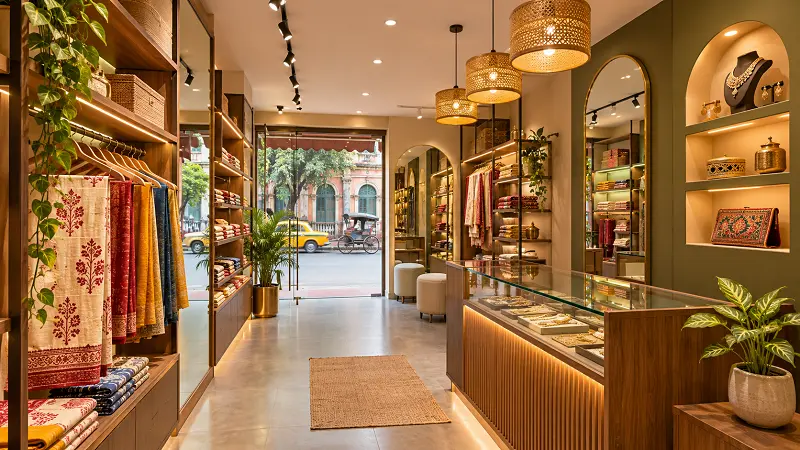
The best small shop decoration ideas aren’t about adding more things. They’re about making a tight space feel open, easy to walk through and impossible to ignore from the street. Good lighting, a clean colour palette, wall-mounted storage and one strong visual feature will do more for a 100 sq ft shop than any amount of decoration.
That matters a lot in Kolkata. Walk through Gariahat, Hatibagan or the lanes around New Market and most shops are narrow, deep and squeezed between neighbours. Customers decide in two or three seconds whether to step inside. At Espace n Design we work on these spaces all the time, from 80 sq ft mobile accessory counters to 400 sq ft boutiques in Salt Lake, and the same handful of ideas keeps paying off. Here they are, along with the furniture choices that make them work.
How can I decorate a small shop on a low budget?
Spend on lighting and the front first, keep the walls light, and use standard modular racks rather than custom carpentry. Those three moves give the biggest visual change per rupee. Decorative extras can wait until sales justify them.
- Fix the lighting before anything else. Replace tube lights with LED panels and add an LED strip under each shelf. Products look sharper, colours look true, and the shop appears cleaner instantly. It’s usually the cheapest upgrade with the most noticeable effect.
- Repaint in one light colour. Off-white, warm grey or soft beige makes walls recede. A single repaint often changes a shop more than new furniture.
- Clear the floor. Old stock boxes, a second chair nobody uses and a stack of carry bags can take up 15% of a small shop. Move storage up to a loft or into closed cabinets under the counter.
- Make one feature wall. Pick the wall customers see first from the door and give it the most attention: a textured laminate, your shop name in acrylic letters, a neon sign or a wallpaper panel. Leave the other walls plain so this one stands out.
- Use what you already have. Old wooden racks can be re-laminated in a single colour rather than replaced. Matching finishes make even second-hand furniture look planned.
How do I make a small shop look bigger?
Use light colours, mirrors, bright even lighting and furniture that sits on the walls rather than the floor. The aim is to let customers see the back wall the moment they step in, because a visible far wall makes any room feel larger.
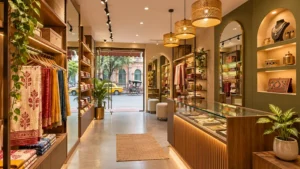
- Add a mirror wall. A floor-to-ceiling mirror on one side wall can make a narrow shop feel almost twice as wide. It works especially well for clothing, jewellery and cosmetics shops, where customers want to see themselves anyway.
- Keep the centre open. In very small shop interior design, a freestanding display table in the middle usually blocks more than it sells. If you need one, keep it low, below hip height, so the eye travels over it.
- Light the back wall. A dark rear wall makes a shop feel like a tunnel. Wash it with light from a ceiling track or a backlit panel and the space suddenly feels deeper.
- Use glass where you can. A glass-top counter, glass shelves in the display unit and a clear glass shop front all let light through and keep sightlines open.
Small shop furniture design: what to build and what to skip
For a small shop, the right furniture is wall-mounted, modular and multi-purpose. Every piece should either display stock, store stock or help close the sale. Anything that does none of those three can probably go.
Good small shop furniture design follows a few rules we apply on almost every project:
- Go vertical with wall systems. Slatwall panels, wall-mounted shelf rails or grid panels with hooks let you change displays without calling a carpenter. Run them from about 1 ft above the floor to 7 ft, and use the space above for boxed stock.
- Make the counter work hard. A small shop counter should have a display top, drawers for billing supplies and a closed cabinet below for stock. Keep it 18 to 20 inches deep instead of the usual 24 to save floor space, and place it to one side rather than across the middle, so customers can walk in alongside it.
- Choose furniture with hidden storage. A trial-room bench with a lift-up seat, a display plinth with a drawer, or a counter with a pull-out shelf. In a 120 sq ft shop, every hidden cubic foot counts.
- Use the right material for Kolkata’s weather. Humidity during the monsoon swells cheap MDF and particle board, and drawers start sticking by August. Go for BWP or MR-grade plywood with laminate, or powder-coated metal for racks. It costs a little more up front and lasts years longer.
Here’s how different shop types usually adapt the same principles:
| Shop type | Furniture that works | Decoration focus |
|---|---|---|
| Clothing or saree shop | Wall rails, pull-out saree drawers, small trial room with mirror | Mirror wall, warm lighting, fabric-friendly colours |
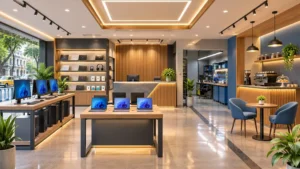
| Mobile and accessories | Slatwall with hooks, glass counter with locks | Bright white light, brand colour accents |
| Sweet shop or bakery | Refrigerated glass counter, wall menu board | Clean whites, warm display lighting |
| Gift or stationery shop | Adjustable open shelves, low centre display | Colourful feature wall, seasonal displays |
| Jewellery or watch shop | Glass display counters, wall showcases with spotlights | Dark or rich feature wall, focused spot lighting |
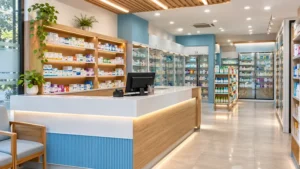
| Pharmacy | Drawer racks, glass counter, fridge space | Neutral palette, bright even light |
What lighting is best for a small retail shop?
Use three layers: bright, even ceiling light for the whole shop, focused spotlights on key products, and a little accent light on the feature wall or signage. For most shops, neutral white light around 4000K shows products accurately while still feeling welcoming.
- Match light colour to what you sell. Cool white (5000K to 6000K) suits pharmacies, electronics and mobile shops, where clarity matters. Warmer light (3000K) flatters clothing, sarees, sweets and jewellery. Most shops do well with a neutral middle setting and a few warmer spotlights on the hero products.
Shoppers walking past at night judge a shop by how bright it looks from the pavement. A well-lit interior, seen through clean glass, is one of the best ideas for shop decoration you can afford.
Which colours make a small shop look attractive?
Light neutrals on most surfaces, with one brand colour used boldly in a single place. White, off-white, light grey and pale wood tones keep a small shop open and let the products provide the colour. Your brand colour should appear on the feature wall, the signage or the counter front, not everywhere at once.
Avoid dark colours on the ceiling and floor in a small shop; they make it close in. The one exception is a premium jewellery or watch store, where a deep blue or charcoal feature wall with strong spotlights can feel exclusive. Even then, keep the rest light.
How should products be arranged in a small shop?
Put the bestsellers at eye level, new or high-margin products near the entry and on the feature wall, and everyday items towards the back so customers walk past everything else to reach them. Group products by type, and leave some breathing space on every shelf rather than packing it full.
- Follow the ‘right turn’ habit. Most customers naturally look and move to the right after entering. Put your strongest display on the right-hand wall.
- Create a small focal display at the entrance. One table, mannequin or stand just inside the door with a few of your best products. Change it every couple of weeks so regular customers notice something new.
Packed shelves feel cheap and make it hard to find anything. A shelf that’s about 80% full looks well stocked and still lets each product be seen.
How can I decorate my shop for festivals?
Keep a simple, reusable kit and change it with the season: fairy lights, a themed backdrop on the feature wall, a festive window display and fresh flowers or marigold strings. Plan it into the design by leaving a few hooks, a power point near the shop front and an empty display spot you can dress up.
- Plan for Kolkata’s big selling seasons. Puja shopping in September and October brings the year’s biggest footfall to Gariahat, Hatibagan and New Market, and Poila Boishakh brings the Haal Khata tradition and Chaitra sales. A shop that’s designed with a removable festive panel or a dedicated window display can change its look overnight without blocking aisles with temporary stands. Durga Puja themes like alpana patterns, terracotta pieces or a dhaak-inspired backdrop connect strongly with local customers.
- Don’t forget the shop front. A small shop design lives or dies at the entrance. An illuminated sign board sized for visibility from across the road, a clean glass front with only one or two posters, and a step-free threshold where possible will bring in more people than any interior decoration.
How much does small shop interior design cost in Kolkata?
It depends on the shop size, the type of furniture, the materials you choose and whether you need civil work like flooring, a false ceiling or electrical rewiring. A simple refresh of paint, lighting and re-laminated furniture costs a fraction of a full fit-out with new modular systems, a counter and a shop front.
Rather than rely on a generic per-square-foot figure, try our interior cost estimate. You share the size and what you want done, and a designer gets back to you with a figure that reflects your actual shop and market.
On timing, most small shops in Kolkata take two to four weeks from final design to handover. If you’re opening before Puja or Poila Boishakh, start the design at least six weeks ahead. Carpenters and electricians get booked up fast in the run-up to both.
Mistakes we see in small shops again and again
A few problems come up on almost every site visit. The counter is placed right at the entrance, so customers queue in the doorway. There are too few power points, so extension cords run across the floor. The shop uses glossy floor tiles that become slippery the moment it rains. The signboard is designed for close viewing and can’t be read from across the road. And shelves are installed at a fixed height, so they can’t adapt when the stock changes.
Fix those five issues and most small shops look and work noticeably better, even before any decoration goes up.
Planning a small shop in Kolkata?
Espace n Design is an interior design company in Kolkata that plans homes, offices and retail spaces. Our team handles commercial interior design in Kolkata for shops of every size, from single-counter kiosks to multi-floor showrooms. We’ll measure the space, plan the layout and furniture around your stock, show you material samples and manage the work through to opening day.
Call or WhatsApp +91 90517 85452 to book a free site visit, or send us a few photos and the dimensions of your shop for a first layout idea.
Frequently asked questions
What is the best layout for a small shop?
For most small shops, a wall-based layout works best: displays and shelves along the walls, the counter on one side, and an open centre. In very narrow shops, run the counter lengthwise along one wall so customers can walk the full depth.
How do I decorate a 10×10 shop?
Keep the walls light, use wall-mounted shelving to the ceiling, place a slim counter on one side, add a mirror on one wall and invest in good LED lighting. Choose one feature wall for your brand name and keep the rest simple.
Which flooring is best for a small shop in Kolkata?
Large-format matt vitrified tiles are the most practical choice. They have fewer joints, look more spacious and stay safe underfoot during the monsoon. Avoid glossy finishes near the entrance.
Is a false ceiling worth it in a small shop?
Usually yes, if the height allows. A simple gypsum false ceiling hides wiring and AC ducts, holds LED panels neatly and makes the shop look finished. Keep it plain; heavy designs make low shops feel cramped.
How often should a small shop update its decoration?
Change product displays every two to three weeks, refresh the seasonal decoration before each major festival, and plan a bigger interior update every five to seven years or when the brand changes.
Can I renovate my shop without closing it?
Often, yes. Work can be phased, with one wall at a time or night shifts for noisy work. Furniture can be built off-site and installed in a day or two, which keeps the closure short.


